.png)

estimated read time: 5 minutes
HUSKY NAVIGATOR
a kiosk system built for UW students to empower students to learn, connect, and travel safely from campus back to their abodes (especially @ night )
role:
ux researcher
ux/ui designer
interaction designer
team :
chinyere munonye
aminta malcom
maham khawar
sahana narendran
tools :
miro
figma
canva
google forms
duration: 8 weeks
CONTEXT
as new UW graduate students, we encountered a shared problem: feeling unfamiliar with, and often unsafe on campus.
with our program, all of our classes begin at 6pm - 10pm, there are many instances where students found themselves commuting from campus late at night and feeling unsafe while navigating campus.
problem space
what’s the problem?
students feeling uneasy commuting home on their own.
Graduate students can feel uneasy commuting home on their own, whether late at night or during the day. Students often feel safer when they have a sense of community.
From conversations with peers, many graduate students shared that
they didn't feel they had this sense of community.
We noticed a gap in graduate students' knowledge of existing on-campus safety resources.
a sense of community + feeling safe on the way home after late classes
what’s the solution?
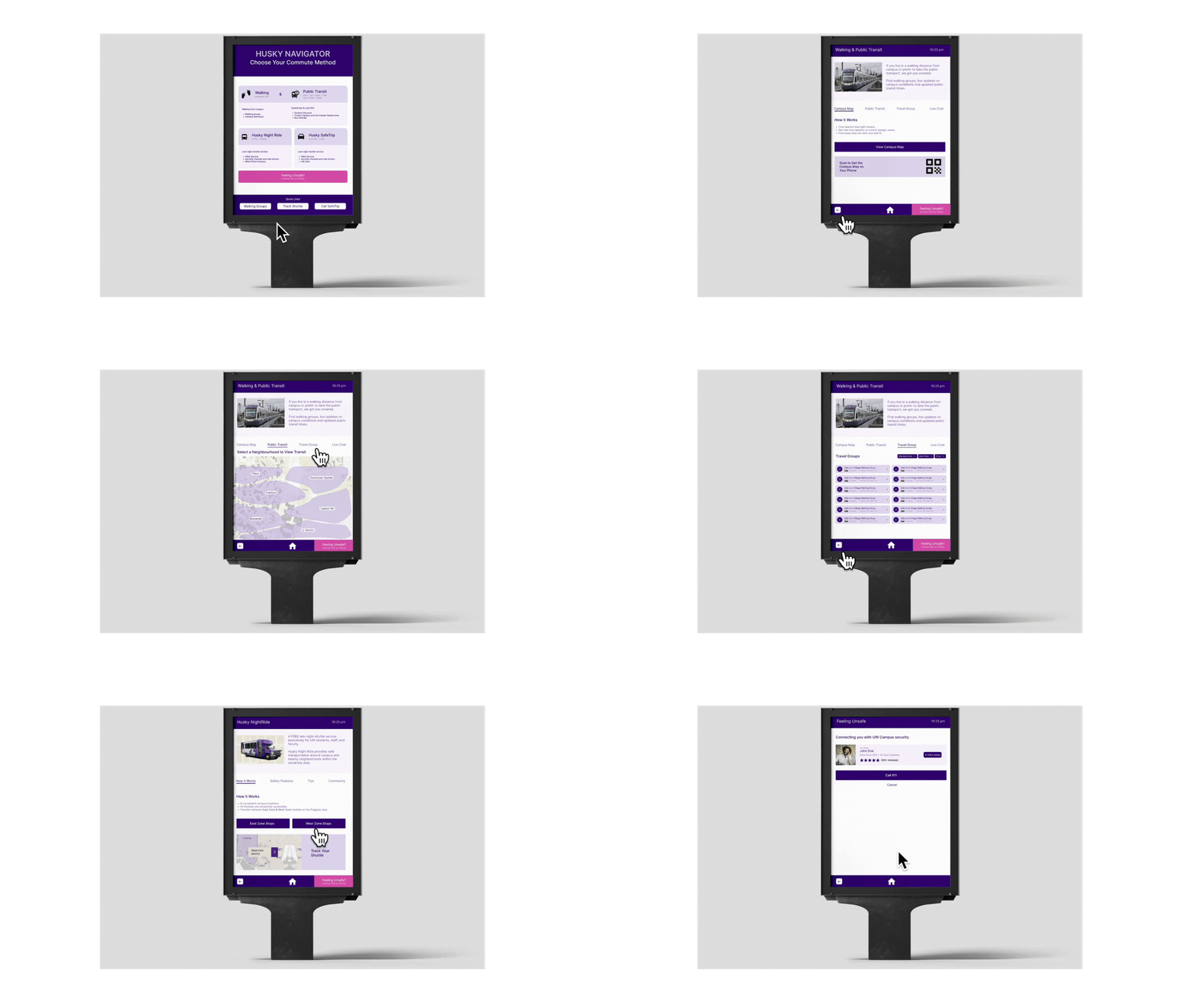
an interactive kiosk that helps students easily access UW transportation resources AND connect with one another
but how will this manifest?? an app , a class presentation??
the husky navigator kiosk 🎉
Using the kiosk, students can
-
book on campus shuttles
-
check real-time safety & shuttle updates
-
explore public transit and walking route options
-
connect with community commute group chats
RESEARCH
Key Takeaways:
-
Students feel significantly safer commuting during the day vs. night
-
Walking was the most frequented commute option
-
Most students commute alone
-
Most students are aware at various levels of the available UW resources
USER RESEARCH
user surveys : majority of students feel significantly less safe walking at night compare to during the day
→ most students commute alone
in depth interviews : the presence of other people significantly increased participants feeling of safety when commuting at night.
→ many students lacked clarity on how to use or where to find campus safety transportation resources
USER PERSONAS

Persona 1 : Noemi P.
Archetype : “ the cautious adventurer”
-> values: higher risk aversion
-> prioritizes the need to commute home safely
-> values connecting with peers
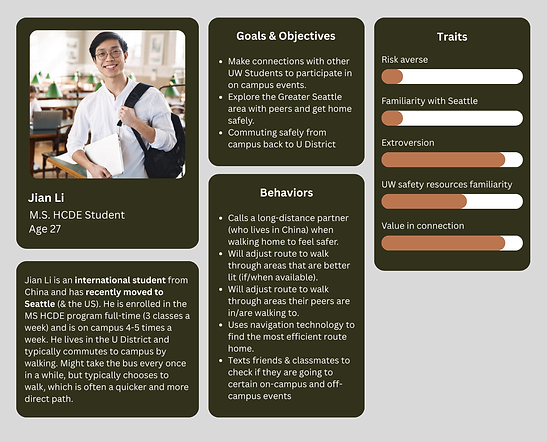
Persona 2 : Jian Li
Archetype : “ the social adventurer”
-> Values: Interested in connecting with peers
-> prioritizes the need to commute home safely
-> international student newly moved to Seattle
SKETCHING


DESIGN
Key Takeaways:
-
The design process is not linear
-
There will be many iterations, just learning where to put a 📌 in it for the time being.
-
VERSION 1 MEDIUM FIDELITY PROTOTYPE :
USABILITY TESTING : MODERATED
We created version 1 of our final design, incorporating each team member's initial low-fidelity designs and interactions to guide our usability study tasks.
These wireframes helped us better understand user needs and preferences. Given our short timeline, combining different design styles let us gather feedback on various interface approaches.
This was important because we'd been brainstorming interface ideas but hadn't seen how they'd look together in a cohesive design.
Based on participant feedback, we added quick links at the bottom of the kiosk screen. This allows users to navigate directly to specific features, letting experienced users access their preferred function immediately.
VERSION 2 ITERATE : HIGH FIDELITY DESIGN
USABILITY TESTING : MODERATED
students preferred a simple design and clarity on functionality of kiosk related to safety and community.
Based on participant feedback, we added quick links at the bottom of the kiosk screen. This allows users to navigate directly to specific features, letting experienced users access their preferred function immediately.
HUSKY NAVIGATOR HOMEPAGE

version 1
version 2

WALKING & PUBLIC TRANSIT PAGE
version 1

version 2


Reflection
what HuskyNavigator taught me about design
This experience showed me:
-> what it's like to work with diverse user experience researchers and designers on a tight timeline.
-> conducting user research and synthesizing qualitative insights.
There are countless solutions that can be derived from one problem.
The most important thing is to always consider the solution that would BEST suit the users you're designing for.
Overall, I had so much fun collaborating with my peers to think outside the box, iterate, and create a product that has the potential to be impactful for students at the University of Washington.
#proud
gratitude
thank you for stopping <3
